
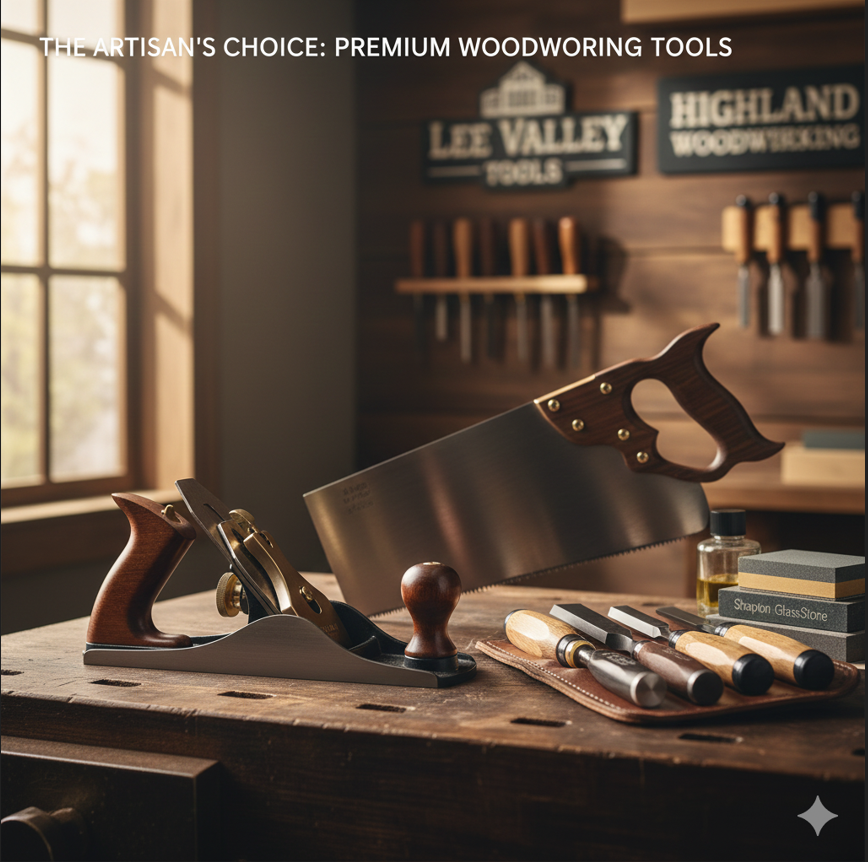
Finding premium woodworking hand tools—those precision-engineered instruments that last for generations—is no longer a matter of visiting a local hardware store. In 2026, the market for high-end “boutique” tools is divided between direct-to-consumer manufacturers like Lie-Nielsen and Veritas, and specialized retail giants such as Lee Valley, Woodcraft, and Highland Woodworking. For serious artisans, buying premium means looking for brands that prioritize hand-finishing, high-carbon steel, and cryogenic tempering, which are rarely found in mass-market retail chains.
I use premium woodworking hand tools often, and they make my work easier. They help me stay organized, finish faster, and keep full control over every step.
1. The Heavy Hitters: Specialized Retailers for 2026
If you prefer to see a tool in person or want to browse a meticulously curated selection of international brands, these specialized retailers are the undisputed industry leaders. They act as the gatekeepers for quality in an era of mass-produced clones.
Lee Valley Tools (USA & Canada)
Widely considered the “Mecca” for woodworkers, Lee Valley is the exclusive home of the Veritas brand. However, they are much more than just a single-brand shop. Their catalog is a masterclass in curation, offering everything from premium Japanese pull-saws to exquisite European carving chisels. In 2026, their customer service remains the gold standard, providing deep technical support for every tool they sell.
Woodcraft & Rockler (National US Hubs)
With dozens of physical storefronts across the United States, Woodcraft and Rockler provide the rare opportunity to actually hold a premium plane or chisel before you commit to the purchase. They are the primary hubs for WoodRiver tools—often cited as the best “value-to-performance” ratio in the premium tier—and carry high-end measuring equipment from brands like Starrett.
Highland Woodworking (Atlanta, GA & Online)
A favorite for the traditionalist, Highland Woodworking feels like a step back into a more craftsmanship-focused era. They are one of the few authorized dealers for Lie-Nielsen Toolworks and stock an incredible array of specialty gear, including Swiss-made carving tools and hand-forged German axes that are nearly impossible to find elsewhere.
Axminster Tools (UK & Europe)
For artisans across the Atlantic, Axminster is the premier destination. They specialize in high-end European brands like Pax saws and Kirschen (Two Cherries) chisels. Their “Professional” line is highly regarded by European trade schools for its durability and precision.
2. Direct-from-Maker: The Boutique Tool Movement
In 2026, some of the world’s most coveted tools never hit a retail shelf. Many master toolmakers have moved to a direct-to-consumer model, ensuring that they maintain total control over quality and the customer experience.
The Gold Standard: Lie-Nielsen Toolworks
Based in Warren, Maine, Lie-Nielsen is the benchmark by which all other modern hand planes are measured. Their designs are heavily influenced by the legendary “Bed Rock” planes of the early 20th century, but they use significantly thicker ductile iron castings and superior tool steel. Because demand often outstrips supply, buying direct from their website or attending one of their regional “Hand Tool Events” is often the only way to secure their flagship smoothing planes and saws.
The Innovation Leader: Veritas (Lee Valley)
While Lie-Nielsen honors tradition, Veritas (the manufacturing arm of Lee Valley) is obsessed with innovation. They are famous for pioneering the use of PM-V11® steel, a powder-metal alloy that offers the sharpening ease of carbon steel with the edge retention of much harder alloys. Buying direct from Lee Valley ensures you have access to their full ecosystem of patented honing guides and specialized joinery planes.
Custom Saws and Professional Kits
-
Bad Axe Tool Works: If you want a saw that is as much a work of art as it is a tool, Bad Axe offers custom-ordered dovetail and carcass saws. You can choose your handle wood, backer material, and even the “file” of the teeth to match your specific woodworking style.
-
RobCosman.com: Rob Cosman has built a reputation not just as a teacher, but as a maker of “wood-ready” tools. His dovetail saws and planes are famously inspected, tested, and sharpened by his team before they ship, meaning you can literally take them out of the box and start making shavings.
3. Importing the East: Japanese Saws and Chisels
Japanese woodworking tools (Daitool) represent a completely different philosophy, focusing on pull-strokes and laminated steels. Because many of these are handmade by individual blacksmiths in Japan, you need specialized importers to ensure authenticity.
-
Hida Tool & Hardware: Based in Berkeley but shipping globally, Hida is a legendary source for authentic Dozuki saws and Ouchi chisels. They specialize in tools that are still made using traditional forging techniques.
-
Shapton & Sigma Power: A premium Japanese chisel is worthless without a proper edge. Importers like Daitool and Osaka Tools provide the high-grit waterstones (like the Shapton GlassStone series) required to maintain the “mirror-finish” edges Japanese tools are famous for.
4. The Checklist: What Makes a Tool “Premium”?
When you are spending $300 on a single hand plane, you aren’t just paying for the name. Look for these “Premium Markers” to ensure you are getting your money’s worth:
-
Sole Flatness: A premium plane should be ground to a tolerance of +/- 0.0015″ or better. Budget planes often require hours of “lapping” on sandpaper to achieve this.
-
Ductile Iron vs. Grey Iron: High-end makers use ductile iron because it is shock-resistant. If you drop a cheap grey-iron plane on a concrete floor, it will shatter; a ductile iron plane will likely survive.
-
Steel Alloy: Demand A2, O1, or PM-V11 steel. These alloys are specifically designed for edge tools and will stay sharp through feet of hardwoods like white oak or maple.
Conclusion: Quality Over Quantity
In the journey of a woodworker, there is a common turning point where you realize that one $350 Lie-Nielsen No. 4 Smoothing Plane will outperform a dozen $50 budget planes. In 2026, the most successful artisans are moving toward a “smaller, better” philosophy. By sourcing from specialized retailers like Lee Valley or buying direct from makers like Bad Axe, you are investing in an heirloom that will only get better with use.
Frequently Asked Questions (FAQs)
1. Why are premium hand tools so much more expensive? You are paying for the quality of materials and the cost of precision. Mass-market tools are “cast and shipped,” whereas premium tools are hand-lapped, the soles are ground perfectly flat, and the blades are cryogenically treated. This saves you hours of “tuning” time.
2. Is it better to buy new premium tools or restored vintage ones? Vintage Stanley planes can be excellent, but they require a high level of skill to restore and “tune.” New tools from Veritas or Lie-Nielsen offer modern ergonomics and superior steel that simply wasn’t available 100 years ago. If you want to spend your time making furniture, buy new.
3. What is the best “first” premium tool for a beginner? The Veritas Low-Angle Jack Plane is widely considered the most versatile first purchase. With different blades, it can handle everything from rough-dimensioning lumber to fine-smoothing and end-grain work on a shooting board.
4. Can I find these brands on Amazon? Generally, no. Elite makers like Lie-Nielsen and Veritas avoid Amazon to maintain quality control and price integrity. While you may find “prosumer” brands like WoodRiver there, the true top-tier gear is sold through specialized channels.
5. How do I protect these expensive tools from rust? High-carbon steel is beautiful but vulnerable. Use a Camellia oil applicator or a Jojoba oil rag to wipe down every metal surface after each use. For long-term storage, many woodworkers use VCI (Vapor Corrosion Inhibitor) paper or drawer liners to create a rust-proof micro-environment.