
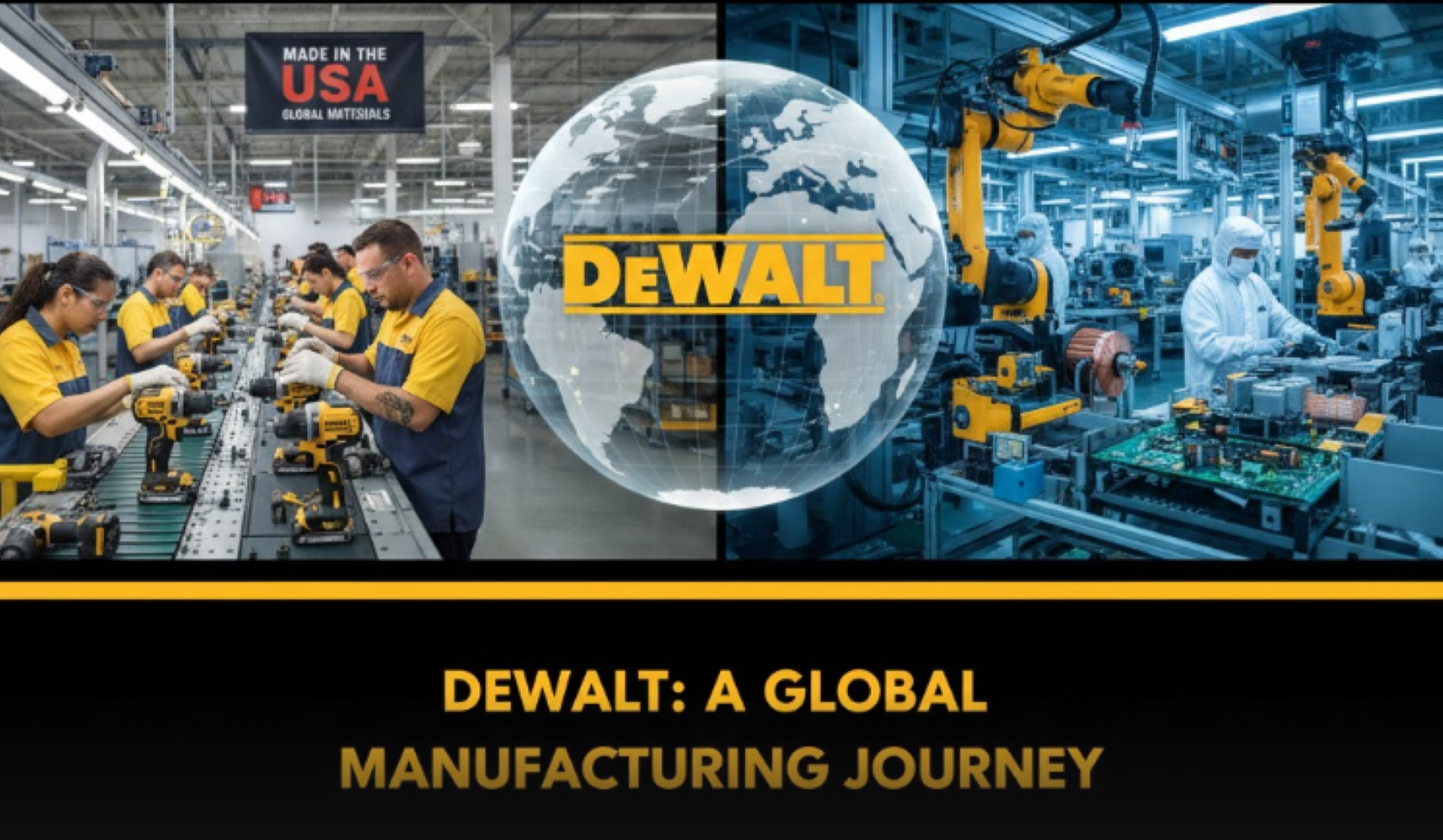
DeWalt power tools are manufactured through a global production network that includes the United States, Mexico, Brazil, China, Italy, the United Kingdom, and the Czech Republic. While DeWalt is an American brand headquartered in Towson, Maryland, it is a subsidiary of the global giant Stanley Black & Decker. To support domestic jobs and consumer demand, DeWalt operates several major facilities in the U.S. that assemble popular cordless and corded tools under the label “Made in the USA with Global Materials.”
I work with many DeWalt power tools for my projects. The right ones take care of the slow parts, like shaping, cutting, and small fixes. They let me focus more on doing the job well instead of spending long hours on small steps.
The Stanley Black & Decker Heritage
To understand DeWalt, you must understand its parent company, Stanley Black & Decker (SBD). Headquartered in Towson, Maryland, DeWalt is the “pro-grade” crown jewel of the SBD portfolio, which also includes legendary brands like Craftsman, Lenox, and Porter-Cable.2
In 2026, SBD continues to follow a “Make Where We Sell” philosophy. This strategy isn’t just about logistics; it’s about agility. By producing tools closer to the people who use them, the company reduces the carbon footprint of shipping and can react faster to local market demands.
Designed in the USA
Even when a tool is assembled halfway across the globe, its “DNA” is strictly American. The primary engineering hubs remain in Maryland, where designers put prototypes through grueling “Heavy Duty” stress tests.3 These engineers ensure that whether a motor is wound in Tennessee or Suzhou, it meets the exact torque and heat-resistance specifications required for professional use.
1. “Made in the USA with Global Materials”
One of DeWalt’s most successful initiatives is its commitment to domestic assembly. You have likely seen the red, white, and blue stickers on tool boxes. This phrasing—“Made in the USA with Global Materials”—is a precise legal distinction required by the Federal Trade Commission (FTC). It means the final transformation of the tool happened on American soil, even if internal components like microchips or magnets were sourced internationally.
As of 2026, DeWalt operates over 30 manufacturing and assembly facilities across the United States. Key locations include:
-
Charlotte, North Carolina: A massive 1.2 million-square-foot facility that serves as a heartbeat for power tool assembly and distribution across the East Coast.4
-
Jackson, Tennessee: This plant has become a focal point for the cordless revolution, specializing in the assembly of high-capacity lithium-ion battery packs.
-
Hampstead, Maryland: A historic location that bridges the gap between DeWalt’s 1924 origins and modern 20V MAX™ technology.
-
Shelbyville, Kentucky & Greenfield, Indiana: These sites focus on high-volume assembly of drills and impact drivers, ensuring that the most popular kits are “Built in the USA.”
2. The Global Manufacturing Network
While domestic production is a point of pride, DeWalt is a global powerhouse that leverages specialized expertise from different regions.5 If your tool doesn’t have the “Made in USA” badge, it likely came from one of these high-tech hubs:
Mexico: The North American Workhorse
DeWalt’s facilities in Mexico are vital. They handle much of the heavy-duty mechanical assembly for the North American market. If you own a DeWalt corded grinder or a mid-range cordless circular saw, there is a high probability it was assembled in Mexico, benefiting from a streamlined supply chain that avoids the delays of trans-oceanic shipping.
China and Vietnam: The Electronics Hubs
The electronics industry is centered in Asia. Components such as brushless motors, LED work lights, and printed circuit boards (PCBs) are largely manufactured in China.
In recent years, DeWalt has significantly expanded its footprint in Vietnam. This move, which accelerated through 2025 and 2026, allows the company to diversify its supply chain, ensuring that global trade fluctuations or regional bottlenecks don’t leave job sites without necessary equipment.
Europe: Precision and Woodworking
For specialized tools like miter saws, planers, and high-end breakers, DeWalt often looks to its European plants in Italy, the United Kingdom, and the Czech Republic. These regions have a long-standing history of precision engineering in woodworking and heavy masonry, making them the ideal home for DeWalt’s most accurate stationary tools.
3. Does the Origin Affect Quality?
This is the most common concern for buyers: Is a drill made in China as good as one made in the USA?
The short answer is yes. DeWalt utilizes a “Unified Quality Standard” across all its global factories. Every plant, whether in South Carolina or Suzhou, must adhere to the same ISO certifications.
-
Testing: Every tool undergoes the same drop tests, motor burn-in cycles, and battery life assessments.
-
Parts: The internal gears and bearings are manufactured to the same metallurgical standards regardless of the factory’s GPS coordinates.
-
Warranty: DeWalt backs its tools with the same three-year limited warranty, no matter where the rating plate says the tool was manufactured.
4. Breaking Down Specific Product Lines
Not all DeWalt products are distributed equally across these factories. Where your tool was born often depends on its category:
| Product Category | Primary Manufacturing Locations |
| PowerStack™ Batteries | Designed in USA; Cells from Asia; Final Assembly in USA/Mexico. |
| FlexVolt® 60V Tools | Heavily featured in the “Built in the USA” program due to complexity. |
| Hand Tools (Knives, Tapes) | Often manufactured in Missouri and Connecticut. |
| Storage (ToughSystem®) | Large-scale injection molding facilities in the USA and Israel. |
| Heavy Machinery | Specialized plants in Italy and Taiwan. |
Why Isn’t Everything 100% “Made in the USA”?
It’s a fair question. To be labeled “100% Made in the USA,” every single sub-component—down to the raw ore used for the steel—would need to be sourced domestically. In the 2026 tech landscape, this is nearly impossible for two reasons:
-
Rare Earth Elements: The powerful magnets used in brushless motors are primarily processed in Asia.
-
Lithium-Ion Chemistry: While battery assembly happens in the US, the specialized chemical cells are currently produced at scale in high-tech “gigafactories” located in Asia and Europe.
By using “Global Materials,” DeWalt can provide the most advanced technology at a price point that remains accessible to the average contractor.
Frequently Asked Questions
How can I tell where my specific tool was made?
Check the rating plate (the black and silver sticker) on the tool body. By law, it must state the country of origin. If it says “Made in the USA with Global Materials,” you are holding a tool assembled in a domestic plant.
Is DeWalt still an American-owned company?
Yes. DeWalt is a subsidiary of Stanley Black & Decker, which is a publicly-traded American company (NYSE: SWK) headquartered in New Britain, Connecticut.6
Conclusion: Are DeWalt batteries made in the USA?
DeWalt has made a massive push to bring battery assembly to the US. While the internal lithium cells are often imported, the final assembly of the casing, protection circuitry, and testing for many 20V and 60V packs occurs in their Tennessee and South Carolina facilitiesC: A Global Strategy with Local Roots
In 2026, the “yellow and black” brand remains a symbol of American industrial strength. While DeWalt leverages a global network to stay competitive and innovative, their commitment to domestic manufacturing is more than just marketing—it is a massive logistical investment that supports thousands of American jobs.
When you buy a DeWalt tool, you are purchasing a product designed in Maryland, powered by global innovation, and—very often—assembled by American hands.