
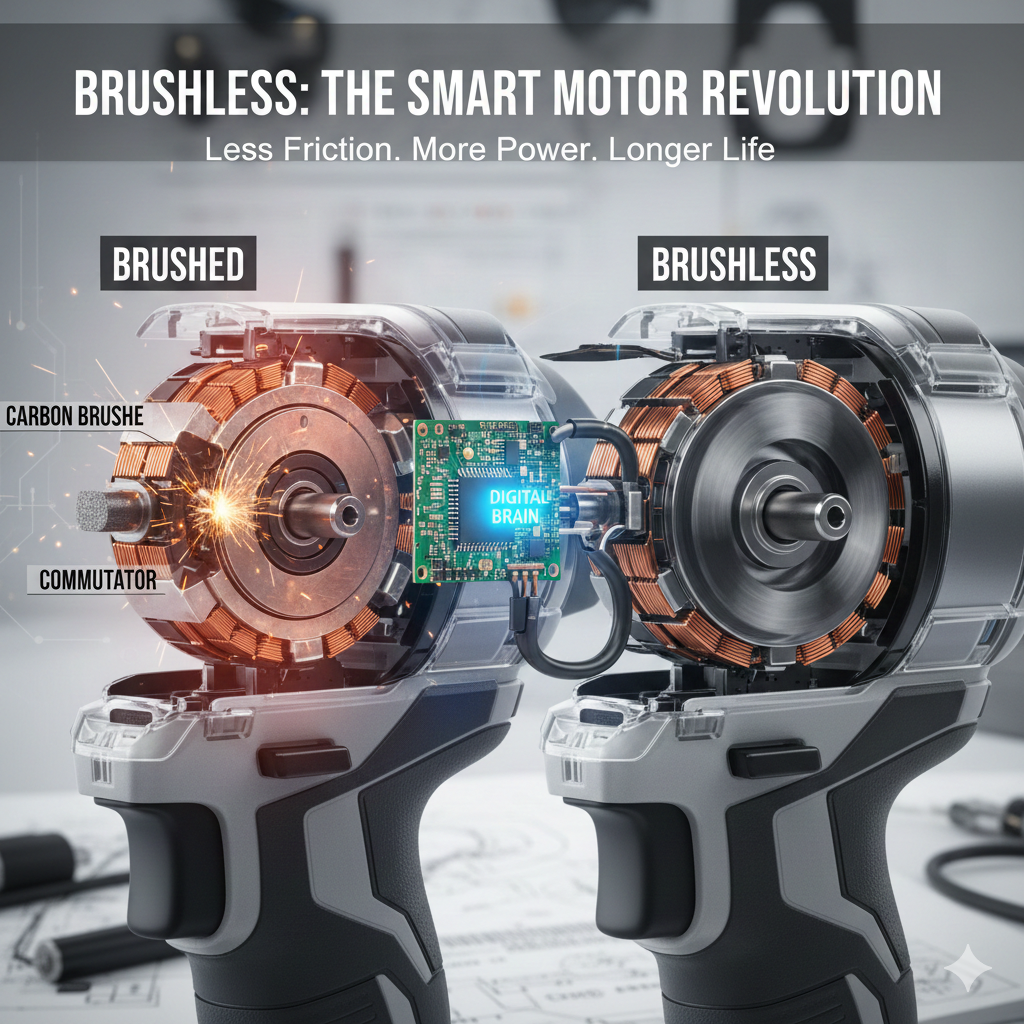
If you’ve stepped into a hardware store or browsed for tools online recently, you’ve likely seen the word “Brushless” emblazoned across the side of drills, saws, and impact drivers. It usually comes with a higher price tag, but what exactly are you paying for? But power tools give the right things of your neccessarity.
I work with many power tools for my projects. The right ones take care of the slow parts, like shaping, cutting, and small fixes. They let me focus more on doing the job well instead of spending long hours on small steps.
In the world of power tools, we are currently living through a digital revolution. The transition from traditional “brushed” motors to “brushless” technology is as significant as the shift from corded tools to lithium-ion batteries. This guide will break down exactly what brushless means, how the technology works, and whether the investment is actually worth it for your specific projects.
What Does “Brushless” Actually Mean?
At its simplest level, brushless refers to the internal design of the electric motor.
In a traditional motor, small blocks of carbon called “brushes” press against a spinning part of the motor to deliver electricity. In a brushless motor, those physical brushes are completely removed. Instead of relying on mechanical contact and friction, the tool uses a digital electronic controller and powerful magnets to generate motion.
Think of it this way: a brushed motor is a mechanical machine, while a brushless motor is a “smart” electronic device. By removing the physical friction of brushes, manufacturers have created tools that are more powerful, more efficient, and significantly more durable.
How it Works: The Electronic Brain vs. The Mechanical Brush
To appreciate why brushless tools are superior, it helps to understand the “flaw” in the original 19th-century motor design that we used for over a hundred years.
The Old Way: Brushed Motors
Traditional motors rely on two carbon brushes that physically rub against a spinning cylinder called a commutator. This contact is how the motor completes the electrical circuit. While effective, this constant rubbing creates three major enemies of performance: friction, heat, and sparks. If you’ve ever looked through the vents of an old drill and seen a faint blue flash while it’s running, you’re seeing the brushes sparking against the commutator. That spark is wasted energy.
The New Way: The Brushless Revolution
Brushless technology flips the script—literally. Here is how the “Smart Motor” functions:
-
The Electronic Brain: Brushless tools replace the physical brushes with a small circuit board called an electronic controller. This board acts as a “brain,” precisely timing the delivery of electricity to the motor’s copper windings.
-
Reverse Architecture: In a brushed motor, the magnets stay still while the copper coils spin. In a brushless motor, the copper coils stay still (the stator) and the magnets spin (the rotor). This allows the tool to be much more compact and efficient.
-
Smart Adjustments: Because the motor is digitally controlled, it can “sense” the resistance of the task. If you are drilling into soft pine, the brain tells the motor to draw very little power. If you hit a hard knot, the controller instantly increases the current to maintain torque. A brushed motor, by contrast, always runs at the same “intensity” regardless of the material.
Key Performance Benefits: Why Professionals Upgrade
In 2026, brushless technology has become the gold standard for anyone using their tools daily. The efficiency gains aren’t just small improvements; they are transformative for the user experience.
1. Massive Gains in Battery Runtime
Because there is no friction-induced energy loss, brushless tools typically get 30% to 50% more work done on a single battery charge. For a contractor or a serious DIYer, this means fewer trips to the charger and higher productivity throughout the day. You are quite literally getting more “work” out of every amp-hour in your battery.
2. Increased Torque and Power
Without the physical bottleneck of carbon brushes, manufacturers can pack more copper into the motor. This leads to a surprising reality: a modern 12V brushless drill can often outperform an older 18V brushed model. The power-to-weight ratio is simply on a different level.
3. Compact and Lightweight Ergonomics
Removing the bulky brush-and-spring assembly allows tools to be much shorter—often up to 2 inches shorter than brushed versions. This makes brushless drills far superior for working in tight cabinets, under sinks, or between wall studs where every centimeter of clearance matters.
Maintenance and Durability: The “Zero-Wear” Advantage
The most common point of failure in a traditional power tool is the carbon brushes wearing down until the motor eventually stops firing. With brushless technology, that headache disappears.
-
No Replacement Parts: A brushless motor is essentially “maintenance-free.” There are no brushes to inspect or replace every few hundred hours of use.
-
Cooler Operation: Heat is the silent killer of electric motors and lithium-ion batteries. By eliminating the friction of brushes, these tools run significantly cooler. This prevents the internal components and battery cells from degrading prematurely, extending the life of your entire tool kit.
-
Job Site Protection: Because brushless motors don’t need massive airflow to cool down physical brushes, they are often designed with sealed housings. This makes them much more resistant to the fine dust and moisture common on construction sites.
Comparison Table: Brushed vs. Brushless
| Feature | Brushed Motor | Brushless Motor |
| Efficiency | ~75-80% (Energy lost to heat) | ~85-95% (Highly efficient) |
| Tool Life | 1,000–3,000 hours | 10,000+ hours |
| Maintenance | Requires brush replacement | Maintenance-free |
| Performance | Constant power delivery | Smart, variable power sensing |
| Initial Cost | Budget-friendly | Premium investment |
Who Should Buy Brushless Tools?
While brushless is technically “better,” it isn’t always the “right” choice for every buyer. You have to weigh the performance gains against the price premium.
The Professional/Contractor
For the pro, brushless is a must. The time saved in battery swaps and the total lack of downtime for repairs easily justifies the 20-30% higher price tag. It is a tool that pays for itself through increased efficiency.
The Serious DIYer
If you are renovating a home, building a deck, or frequently working on automotive projects, the increased torque and reduced fatigue of brushless tools make a noticeable difference. You will appreciate the extra power when driving long lag bolts or drilling through masonry.
The Occasional Homeowner
If you only use a drill twice a year to hang a picture frame or assemble IKEA furniture, a brushed motor tool is perfectly adequate. Brushed tools are significantly more affordable and will still last a decade if used infrequently.
Conclusion: Investing in the Future
Brushless technology has effectively moved power tools from the “mechanical age” into the “digital age.” By replacing physical friction with electronic intelligence, we now have tools that are smaller, faster, and far more durable than anything available just a decade ago.
As we move through 2026, the gap between brushed and brushless will only widen. If you value longevity, runtime, and power, “going brushless” is the single best investment you can make in your hardware collection.
Frequently Asked Questions (FAQs)
1. Is a brushless tool more powerful?
Yes. Because there is no energy lost to friction and heat, a brushless motor can convert more of the battery’s electricity into raw torque and rotational speed.
2. Why are they more expensive?
The cost comes from the electronic controller (the brain) and the high-grade permanent magnets required. While a brushed motor is a simple mechanical circuit, a brushless motor requires a specialized computer chip to function.
3. Do they sound different?
Yes. You may notice a slight high-pitched “whine” when the tool starts or stops—this is the sound of the electronic controller communicating with the motor. Generally, they are quieter because they lack the mechanical “clicking” of carbon against metal.
4. Can I use my old batteries?
Usually, yes. Major brands like Milwaukee, DeWalt, and Makita have designed their brushless tools to be compatible with their existing battery platforms. However, to get the absolute maximum performance, using “High Output” batteries is recommended.