
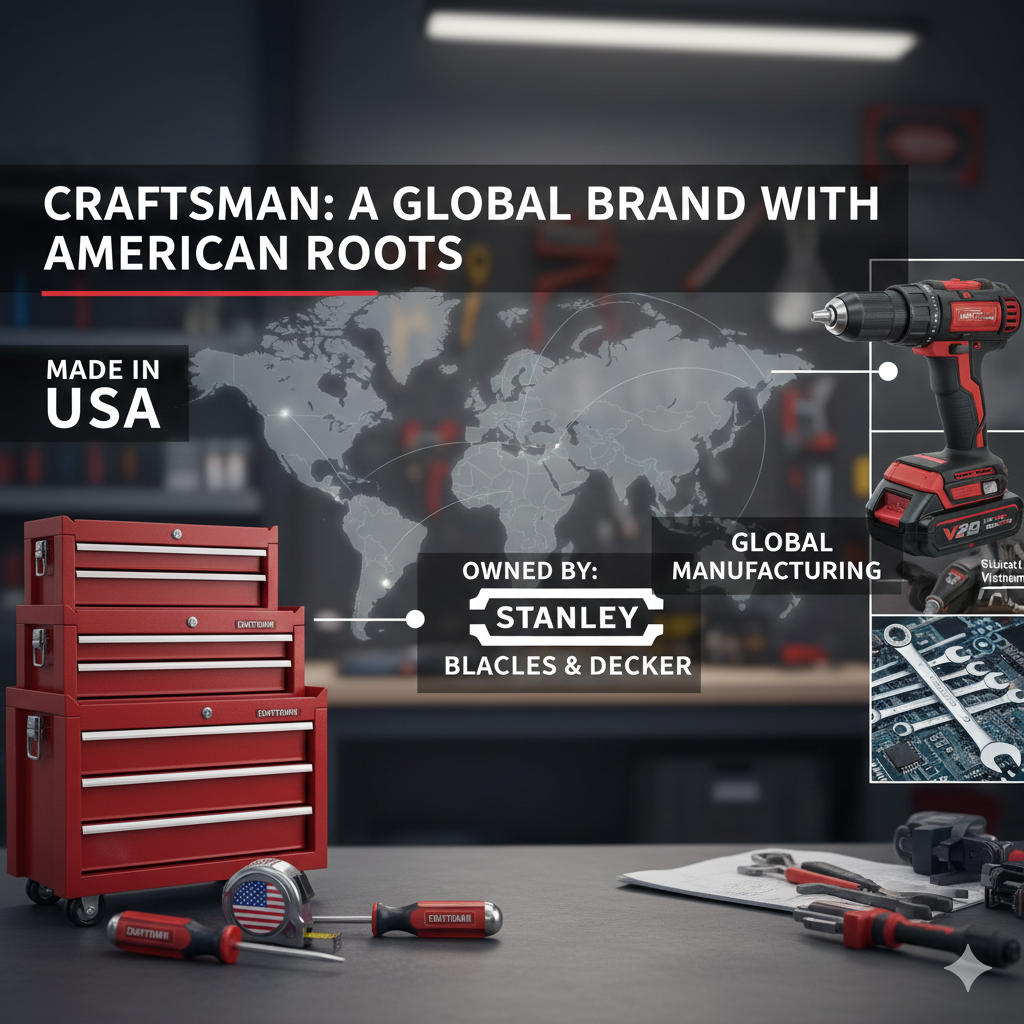
If you grew up with a set of red-handled screwdrivers or a steel toolbox in your garage, you likely have a soft spot for Craftsman. For nearly 90 years, it was the “house brand” of Sears, representing the gold standard of American middle-class reliability. However, if you’ve walked into a hardware store recently, you’ve probably noticed that the landscape has changed. Sears locations have largely vanished, yet Craftsman tools are everywhere—from Lowe’s and Ace Hardware to Amazon.
This shift has left many tool enthusiasts asking: Who actually makes Craftsman tools now? Are they still American-made, or has the quality changed under new management? In this guide, we will dive deep into the modern era of Craftsman, exploring its parent company, its global manufacturing footprint, and what the brand stands for in 2026.
The Stanley Black & Decker Era: A Strategic Rebirth
The biggest turning point in the brand’s history occurred in 2017, when Stanley Black & Decker (SBD) acquired Craftsman from Sears for approximately $900 million. This wasn’t just a change in ownership; it was a rescue mission.
SBD is a Fortune 500 powerhouse headquartered in Towson, Maryland. By adding Craftsman to their portfolio, they created a “family” of brands that dominates the market:
-
DeWalt: The high-end professional choice.
-
Stanley: The leader in hand tools and measuring equipment.
-
Black+Decker: The entry-level, homeowner-focused brand.
-
Craftsman: Positioned perfectly in the middle—the “Prosumer” brand for serious DIYers and automotive enthusiasts.
Shared Technology: The “Cousin” Benefit
One of the most exciting developments in 2026 is how Craftsman benefits from its “cousins.” Because SBD owns DeWalt, many modern Craftsman V20 cordless tools share internal battery technology and motor designs with DeWalt’s professional lines. While they are tuned for a different price point, the “guts” of the tool often come from the same world-class R&D labs.
Manufacturing in the USA: Pride and Production
For many tool users, the “Made in the USA” stamp is more than just a label—it’s a promise of quality. Upon taking over, Stanley Black & Decker launched a massive initiative to “re-Americanize” the brand. As of 2026, they operate roughly 30 manufacturing plants across the United States that contribute to the Craftsman catalog.
Tool Storage: The Pride of Missouri
If you buy a Craftsman metal tool chest or a rolling cabinet today, there is a very high probability it was made in Sedalia, Missouri. This facility is one of the largest tool storage production plants in the world. For decades, it has been a hub of American steelwork, and SBD has doubled down on this location to ensure Craftsman remains the leader in garage organization.
Hand Tools and Accessories
SBD has strategically placed specific product categories in American plants to maintain the brand’s legacy:
-
Tape Measures: Most of these are produced in New Britain, Connecticut, the historic home of Stanley.
-
Knives and Saws: Many are manufactured in Cheraw, South Carolina, utilizing local expertise in blade smithing and assembly.
-
Mechanics’ Tools: While the brand faced a highly publicized closure of a highly-automated plant in Fort Worth a few years ago, they have since integrated domestic production of premium sockets and ratchets into other existing U.S. facilities to keep the “Made in USA” flag flying for high-end sets.
The Global Supply Chain: Why Asia Still Matters
Despite the push for domestic manufacturing, Craftsman is a global brand. To keep prices attainable for the average homeowner, a significant portion of production remains international. This is a reality for almost every major tool brand in 2026.
China and Taiwan
The majority of Craftsman’s V20 cordless power tools, impact drivers, and complex electronic equipment are manufactured in China. This is largely due to the established infrastructure for battery technology and microelectronics in that region.
Taiwan, on the other hand, is the hub for many mid-to-high-tier hand tools. Taiwanese manufacturing is world-renowned for its precision in steel forging, often producing tools that are indistinguishable in quality from European or American counterparts.
Diversifying into Vietnam
In recent years, you may have noticed more “Made in Vietnam” labels on your tool kits. SBD has expanded production here to diversify its supply chain, ensuring that global trade shifts or tariffs don’t interrupt the availability of tools for consumers.
Where to Find Craftsman in 2026
The way we shop for Craftsman has changed completely since the Sears era. The brand is now more accessible than ever through a massive retail network.
-
Lowe’s Home Improvement: This is the primary home for Craftsman. Lowe’s stocks the full range, from heavy-duty storage to lawn mowers and the latest brushless power tools.
-
Ace Hardware: For those who prefer a local, “neighborhood” feel, Ace remains a major partner, stocking a curated selection of hand tools and yard equipment.
-
John Deere Dealer Network: In a unique industry move, some Craftsman outdoor power equipment is now sold alongside John Deere products, thanks to high-level alliances in the manufacturing world.
Quality Check: Understanding the Labels
When shopping for tools in 2026, it is vital to read the fine print. You will often see the phrase: “Made in the USA with Global Materials.”
-
What it means: This typically means the tool was assembled, tested, and packaged in an American factory using some components (like raw steel, specialized bearings, or internal motors) sourced from international suppliers.
-
The V-Series™ Distinction: To satisfy professional mechanics, Craftsman introduced the V-Series™. These tools are engineered with higher specifications, tighter tolerances, and premium finishes, often featuring different manufacturing origins than the standard consumer-grade tools found in “big box” kits.
Conclusion: A Global Brand with American Roots
Craftsman is no longer the Sears-only brand our parents grew up with. Under the stewardship of Stanley Black & Decker, it has evolved into a sophisticated, hybrid manufacturer. By balancing American-made storage and hand tools with high-volume electronic manufacturing in Asia, SBD has managed to keep Craftsman relevant, affordable, and high-performing in 2026.
While the “Made in the USA” landscape is more complex than it was 40 years ago, the brand remains an American icon, engineered and managed by people who value its 100-year legacy.
Frequently Asked Questions (FAQs)
1. Is Craftsman still owned by Sears?
No. Sears sold the brand to Stanley Black & Decker in 2017. While a few remaining Sears stores may still sell the tools through a licensing deal, they have no part in the design or manufacturing of the brand.
2. Are all Craftsman wrenches made in the USA?
No. While there is a specific line of mechanics’ tools explicitly labeled “Made in the USA,” many of the standard sets sold in bulk are manufactured in China or Taiwan. If domestic origin is important to you, always check the individual tool for the “Made in USA” stamp.
3. Does DeWalt make Craftsman power tools?
Not exactly, but they are “cousins.” They share the same parent company and often the same engineering teams. A Craftsman drill is built to a different spec than a DeWalt, but it’s built with the same expert knowledge.
4. Is the lifetime warranty still valid?
Yes! One of SBD’s first promises was to honor the legendary Craftsman lifetime warranty. You can typically walk into a Lowe’s or Ace Hardware with a broken hand tool and exchange it for a new one on the spot.