
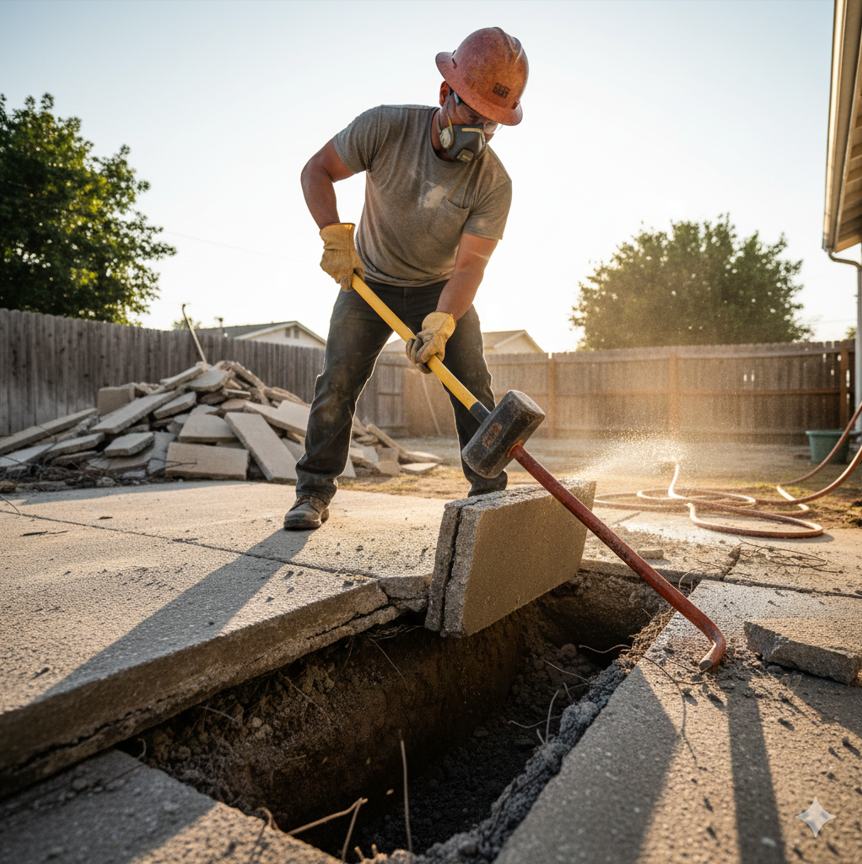
Breaking concrete by hand is a grueling task, but with the right leverage and physics, it is manageable for slabs under 4 inches thick. In 2026, the strategy has moved away from “brute force” and toward undermining and leverage. By creating a void beneath the concrete and using a heavy sledgehammer to strike over that air gap, you allow the concrete to snap under its own weight rather than absorbing the blow into the earth.
I work with many hand tools for my projects. The right ones take care of the slow parts, like shaping, cutting, and small fixes. They let me focus more on doing the job well instead of spending long hours on small steps.
1. The Physics of the Break: Why “Undermining” is Everything
The biggest mistake most people make when picking up a sledgehammer is swinging at the center of a solid slab that is sitting directly on the ground. When you do this, the compacted dirt beneath the concrete acts as a giant shock absorber. The energy from your swing is transferred through the concrete and into the earth, leaving the slab perfectly intact while your joints absorb the vibration.
To break concrete effectively, you must understand that concrete is incredibly strong under compression (pushing down) but relatively weak under tension (stretching or bending).
Creating the “Air Gap”
The secret to a successful manual break is undermining. Before you ever swing a hammer, you need to create a void. Use a pickaxe or a shovel to dig out 4 to 6 inches of soil from underneath the edge or corner of the slab.
By removing the support, you turn the concrete into a bridge. When you strike the “overhang” above that empty space, the concrete has nowhere to transfer the energy except into its own internal structure. Because there is no ground to push back, the slab snaps under its own weight and the force of the blow.
Work from the Outside In
Never try to “crack the nut” from the middle. Always start at the corners or the leading edges. Aim to break off chunks that are roughly 12 inches square. This size is a “sweet spot”—large enough to make progress quickly, but small enough to be lifted and moved into a wheelbarrow without throwing out your back.
2. The Essential Toolkit for 2026
You don’t need a garage full of equipment, but you do need the right “leverage multipliers.” In 2026, tool design has focused heavily on reducing recoil vibration, which is the leading cause of “white finger” and joint fatigue in demolition workers.
The Sledgehammer (8-12 lbs)
While a 20-pound sledgehammer looks impressive, it is often the wrong tool for the job. An 8-pound sledgehammer allows for higher swing velocity and much better accuracy. In physics, force equals mass times acceleration ($F = ma$). By using a lighter hammer that you can swing faster, you often generate more “shattering” force than a heavy hammer you can barely lift. Look for a model with a fiberglass or composite handle, as these dampen the “sting” far better than traditional wood.
The Heavy-Duty Pry Bar (San Angelo Bar)
A 60-inch steel pry bar, often called a “San Angelo” bar, is your best friend. Once you’ve created a small crack with the sledgehammer, you jam the pointed end of the pry bar into the crevice. By using the bar as a lever, you can snap off large sections of the undermined concrete with minimal effort.
The Pickaxe or Mattock
This is your primary tool for the undermining phase. The pointed end is perfect for prying out the sub-base (gravel and dirt) from beneath the slab, while the flat blade can be used to clear debris.
Cold Chisel and Masonry Hammer
If you are working near a foundation or a buried utility pipe, you cannot swing a sledgehammer wildly. Use a cold chisel to “score” a line across the concrete. By creating a literal line of weakness, you can control exactly where the concrete will crack when you give it a firm tap with a masonry hammer.
3. Dealing with the “Skeleton”: Rebar and Mesh
Pure concrete is easy to break. However, most modern slabs (even residential ones) are reinforced with steel to prevent settling. If your concrete has a “skeleton,” your sledgehammer will crack the rocks, but the pieces will stay stubbornly held together.
Cutting Wire Mesh
Most sidewalks use 6×6 welded wire mesh. Once you have shattered a section of concrete, the wires will be exposed. Do not try to break these with a hammer; the mesh is elastic and will cause the hammer to bounce back dangerously. Instead, use a pair of heavy-duty bolt cutters. Snip the wires as you go to free the individual chunks.
Managing Rebar
If you hit 1/2-inch steel rebar, bolt cutters won’t cut it. In a manual-only scenario, you will need a hacksaw with a carbide-grit blade. However, this is the one area where most pros in 2026 recommend a “hybrid” approach. A small cordless angle grinder with a diamond cutoff wheel will save you hours of grueling manual sawing.
4. Safety and Body Mechanics: Protect the Machine
Manual demolition is an “ultra-endurance” event for your body. To avoid injury, you must treat your body like a machine.
-
The “Drop” Technique: Never swing a sledgehammer like a baseball bat. This puts extreme torque on your lower spine. Instead, lift the hammer vertically using your legs. Once it reaches its peak, simply “guide” it down. Let gravity and the weight of the hammer head do the work.
-
The Slide Grip: As the hammer falls, slide your dominant hand down the shaft toward your other hand. This increases the whip-like velocity of the head right before impact.
-
Lung Protection: This is the most overlooked safety step. Breaking concrete creates crystalline silica dust. If inhaled, these microscopic shards of stone can cause permanent lung scarring (Silicosis). In 2026, the standard is to wear a well-fitted N95 or P100 respirator, even for outdoor jobs.
-
Eye Protection: Concrete doesn’t just crack; it “spalls.” Small, razor-sharp chips can fly off at high speeds. Always wear Z87+ rated safety glasses that wrap around the sides of your face.
5. Frequently Asked Questions (FAQs)
How thick of a slab can I realistically break by hand?
The practical limit for hand tools is 4 inches (10cm). This is the standard thickness for most residential sidewalks, patios, and driveways. If you encounter a 6-inch slab or a reinforced footing, the physical energy required to break it manually becomes inefficient, and renting a jackhammer is highly recommended.
How do I prevent dust without making a muddy mess?
The “Wet Method” is best. Use a spray bottle or a garden hose on a “mist” setting to keep the surface of the concrete damp. You don’t want standing water, just enough moisture to “trap” the dust particles before they become airborne.
What should I do with the “Urbanite” (broken concrete)?
Don’t just pay to dump it! Clean broken concrete is often called “urbanite” and is highly prized by landscapers. You can stack the flat pieces to create beautiful, rustic-looking dry-stack retaining walls or use them as a sturdy base for a new garden shed.
How do I know if I’m hitting a pipe?
In 2026, the rule is simple: Call 811 (in the US) before you start. They will come out and mark your gas, water, and electric lines for free. If you see a colored line on your concrete, do not use a sledgehammer or pickaxe within 24 inches of that mark.
Conclusion: Strategy Beats Strength
Breaking concrete by hand is a grueling task, but it doesn’t have to be a miserable one. By focusing on undermining the slab and using the right leverage tools, you can turn a daunting demolition project into a manageable afternoon of exercise. Remember: the sledgehammer creates the crack, the pry bar creates the separation, and the bolt cutters free the piece.