
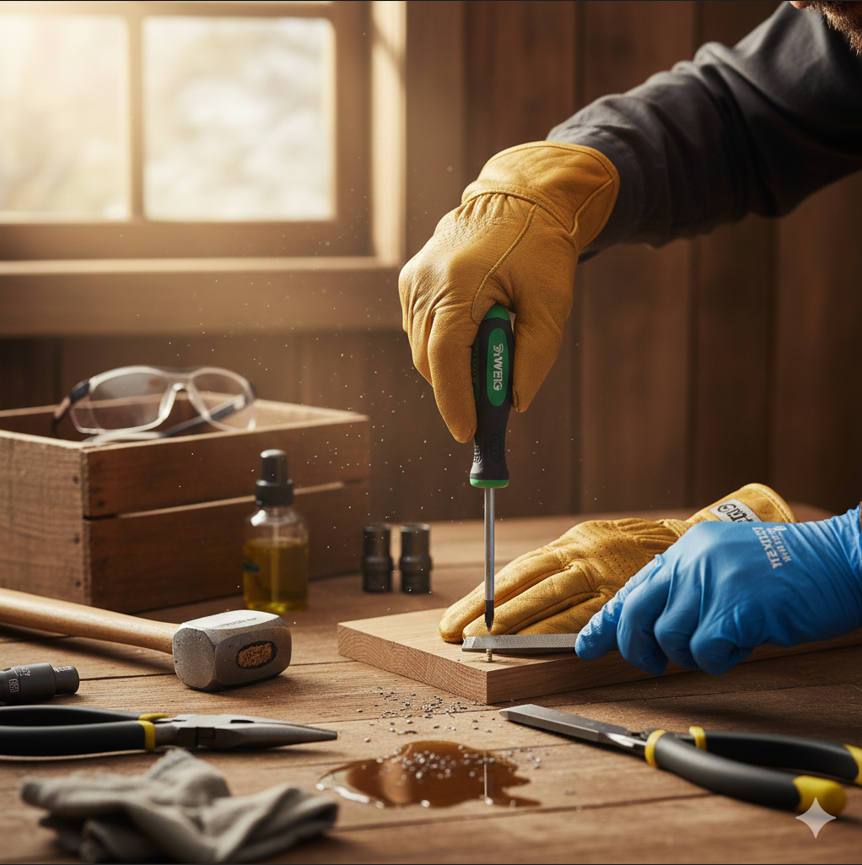
Using hand tools properly is a blend of mechanical leverage, body alignment, and preventative safety. In 2026, the standard for manual work has shifted toward “Active Ergonomics”—the practice of aligning your tool’s center of gravity with your body’s natural range of motion to prevent repetitive strain. Whether you are driving a screw or swinging a hammer, the goal is to let the tool’s engineering do the work while your body provides stable, controlled guidance.
I use hand tools often, and they make my work easier. They help me stay organized, finish faster, and keep full control over every step.
Master the Grip: The Foundation of Control
Everything begins where your skin meets the handle. A common mistake is the “death grip”—squeezing the tool as hard as possible. This doesn’t just tire you out; it actually reduces your accuracy because your muscles become too tense to make fine adjustments.
The 70% Grip Rule
For most manual tasks, aim for a grip strength that is roughly 70% of your maximum power. This is the “Goldilocks zone.” It is firm enough to ensure the tool won’t fly out of your hand if it hits a knot in the wood, but relaxed enough to allow your muscles to absorb the shock of an impact.
Neutral Wrist Alignment
In 2026, we are more aware than ever of repetitive strain injuries. The most critical rule is to maintain a neutral wrist. Your wrist should remain a straight extension of your forearm. If you bend your wrist while applying heavy force—especially when using pliers or a screwdriver—you are putting extreme pressure on the carpal tunnel. Over time, this leads to numbness and long-term damage. If the angle is awkward, move your body or the workpiece, not your wrist.
Choosing Your Grip Style
-
The Power Grip: Wrap all four fingers and your thumb around the handle. Use this for heavy-duty tasks like using a wrench or a hammer where maximum stability is required.
-
The Tripod Grip: Hold the tool with your thumb, index, and middle finger (like a pencil). This is essential for precision work, such as using a fine-tip screwdriver or a marking gauge, where sensitivity is more important than strength.
Tool-Specific Instructions for Peak Efficiency
Each category of tool has its own “mechanical personality.” To use them properly, you have to play to their strengths.
Striking Tools: Hammers and Mallets
A hammer is a force multiplier. If you “choke up” on the handle (holding it near the head), you are fighting the tool’s design.
-
The Swing Technique: Grip the handle near the end. This increases the arc of the swing, which in turn increases the velocity of the head. Swing primarily from your elbow and shoulder. Use your wrist only at the very end of the motion to “snap” the head into the target for precision.
-
Square Impact: Always ensure the face of the hammer hits the target perfectly flat. If you hit at an angle, the hammer can “skitter” off the nail, potentially damaging your workpiece or, worse, your thumb.
Turning Tools: Screwdrivers and Wrenches
Turning a fastener isn’t just about twisting; it’s about axial pressure.
-
The 80/20 Rule for Screwdrivers: When driving a screw, apply 80% of your effort into pushing the driver into the screw head and only 20% into the actual turning motion. This keeps the tip seated and prevents “cam-out”—the annoying slip that strips the screw head and ruins your day.
-
Pull, Don’t Push: When using a wrench, always position yourself so you are pulling the tool toward your body. If the bolt suddenly breaks loose while you are pushing, your momentum will carry your knuckles straight into the nearest sharp metal edge. If you absolutely must push, use the palm of an open hand rather than gripping the handle, so your hand can fly free if the tool slips.
Maintenance: The Hidden Safety Requirement
In 2026, we no longer view maintenance as a “Sunday chore.” It is a fundamental safety requirement. A neglected tool is an unpredictable tool.
The Sharpness Paradox
It sounds counterintuitive, but dull tools are more dangerous than sharp ones. A dull chisel or hand saw requires you to use excessive force to make a cut. When you apply that much pressure, the tool is much more likely to slip. Because you are pushing so hard, you have no way to stop the tool before it causes a deep injury. Keep your edges honed.
Managing “Mushroomed” Heads
If you use steel chisels or punches, the end you strike with a hammer will eventually start to splay out, looking like a mushroom. These metal burrs are incredibly dangerous. If you hit a mushroomed head, a piece of that metal can shear off and act like a high-speed piece of shrapnel. Use a metal file to regularly grind these burrs back down to a clean, beveled edge.
Clean and Lubricate
After every session, wipe your tools down. Use a light, rust-inhibiting oil (like WD-40 Specialist or a natural Jojoba oil). This prevents “flash rust,” which can ruin the tight tolerances of a high-end tool.
Universal Safety Protocols for 2026
No matter how small the project, these professional protocols are non-negotiable:
-
Cut Away: This is the first rule taught to apprentices. Always move a blade or chisel in a direction away from your body and your “off-hand” (the hand holding the material).
-
The Vise is Your Friend: Never try to hold a small piece of wood or metal in one hand while using a tool on it with the other. If the tool slips, your hand is the target. Secure the work in a bench vise or with C-clamps.
-
PPE (Personal Protective Equipment): Even if you aren’t using power tools, wear Z87+ rated safety glasses. A piece of wire can snap, or a wood chip can fly off a chisel with enough force to cause permanent eye damage.
-
The “No-Pocket” Rule: Never carry a screwdriver, utility knife, or chisel in your pocket. If you trip or fall, those tools become dangerous. Use a dedicated tool belt or a carry-all bucket.
Frequently Asked Questions (FAQs)
Can I use a screwdriver as a small pry bar?
Absolutely not. Screwdrivers are engineered for torque (twisting), not lateral (sideways) pressure. The steel in a screwdriver is hardened to be stiff, which makes it brittle. If you use it to pry, the tip will likely snap off, often sending a small piece of steel flying toward your face.
How do I know if my hammer handle is safe to use?
Check the “eye”—the hole where the handle enters the metal head. If you see any gaps, or if the head wiggles even slightly, stop using it. For wooden handles, you can often “reset” the head by driving a new steel wedge into the top. If the handle is fiberglass and shows cracks or fraying, it’s time to replace it.
Why does my hand cramp up during long projects?
Cramping is usually a sign of “static loading”—holding the same position for too long. To prevent this, take a 5-minute “micro-break” every 20 minutes. Stretch your fingers out wide, rotate your wrists, and shake out your hands to restore blood flow.
Conclusion: Working Smarter, Not Harder
Properly using hand tools is an art of conservation. You are conserving your energy, your tools, and your health. When you focus on neutral wrist positions, correct axial pressure, and a clean workspace, you transition from a casual user to a skilled craftsperson.
The mark of a master in 2026 isn’t just a beautiful finished product; it’s a toolset that still looks new and a body that isn’t aching at the end of the day. Respect the physics, respect the tool, and the tool will respect you.