
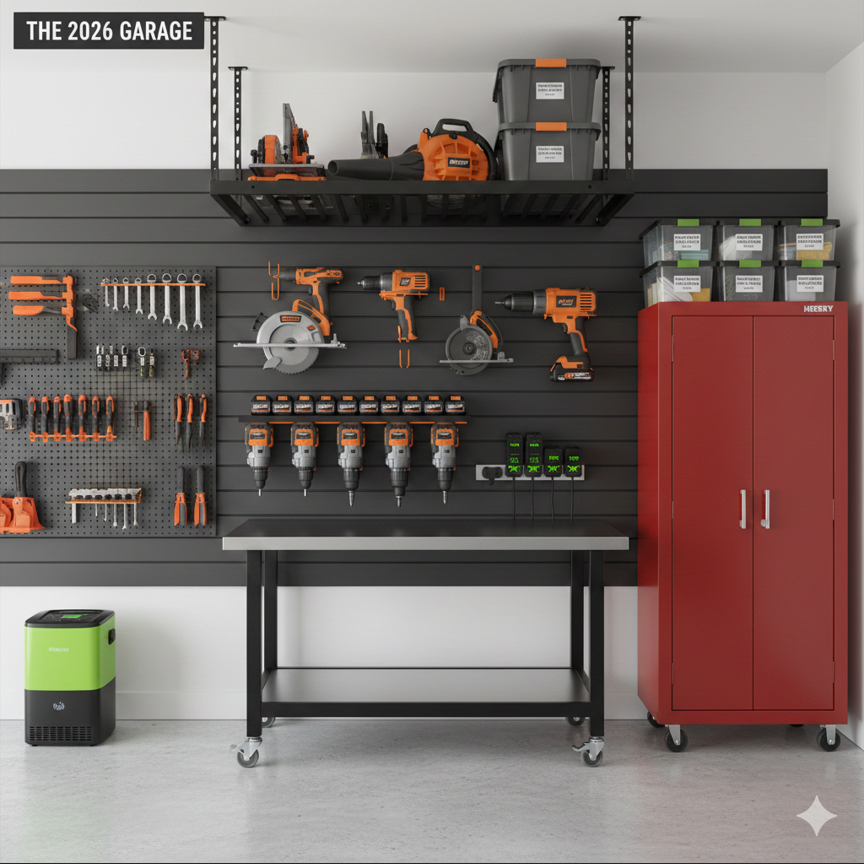
Properly storing power tools in a garage is not just about organization; it is about protecting a significant financial investment from the “garage elements”—moisture, temperature swings, and dust. As of 2026, the best practice for garage storage has shifted toward modular vertical systems and climate-focused battery care. By moving tools off the floor and into dedicated, moisture-resistant zones, you can extend the life of your equipment by years.
I work with many store power tools tools for my projects. The right ones take care of the slow parts, like shaping, cutting, and small fixes. They let me focus more on doing the job well instead of spending long hours on small steps.
1. The Vertical Strategy: Mastering the “Wall of Power”
In a modern garage, floor space is the most valuable real estate you own. Whether you are navigating around a vehicle or a half-finished woodworking project, a cluttered floor is a safety hazard and a recipe for tool damage. The most effective way to store power tools today is to embrace the vertical plane.
Slatwall and Track Systems
High-strength panels, such as Trusscore SlatWall or Rubbermaid FastTrack, have become the 2026 industry standard for a reason. Unlike traditional wooden pegboards that can sag or strip over time, these modern PVC or metal systems offer immense weight capacities. They allow you to “snap-in” specialized hooks designed specifically for the unique shapes of circular saws, reciprocating saws, and even heavy cordless leaf blowers. The beauty of these systems lies in their modularity; as your tool collection grows, you simply slide the hooks to make more room.
Dedicated Drill Stations
If there is one “must-have” for the organized garage, it is the slotted drill rack. These stations allow your cordless drills and impact drivers to hang upside down by their handles. This position is ideal because it keeps the heavy motor housing stable, protects the chuck from collecting dust, and clears your workbench for actual work. Many of these stations now include integrated shelves on top for spare batteries or bit sets, creating a “one-stop shop” for your most-used tools.
Overhead Storage for the “Heavy Lifters”
Not every tool needs to be at arm’s reach. For seasonal items or bulky equipment like table saws and miter saws that only see occasional use, ceiling-mounted racks are a game-changer. Brands like Fleximounts offer heavy-duty steel racks that can support up to 600 lbs. Utilizing the space above your garage door or along the perimeter of the ceiling keeps these heavy items out of the way while preventing the moisture damage that often occurs when tools sit directly on a cold concrete slab.
2. Battery and Charger Maintenance: The 2026 Protocol
In 2026, we are living in a cordless world. While lithium-ion technology has improved significantly, batteries remain the most sensitive—and expensive—component of your tool kit. Heat and cold are silent killers for battery cells, and improper storage is the leading cause of premature failure.
The 40-60% Rule
It is a common mistake to store batteries either completely dead or fully charged at 100% for long periods. For optimal “shelf life,” aim to store your batteries at approximately 50% charge. This “half-full” state minimizes the internal chemical stress on the lithium-ion cells during the off-season. If you know you won’t be using a tool for several months, check the charge level before tucking it away.
Debunking the “Insulated Garage” Myth
Many homeowners believe that an insulated garage door provides enough protection for electronics. However, in many climates, winter temperatures can still plummet below the safe threshold of 4°C (40°F). Lithium-ion batteries do not handle freezing well. During extreme winter or peak summer months, the best practice is to move your batteries—not necessarily the tools themselves—into a temperature-controlled environment. A kitchen pantry, a utility closet, or a basement shelf will keep your batteries in the “Goldilocks zone,” ensuring they are ready to perform when spring arrives.
Centralized Charging Hubs
To prevent a tangled mess of cords, designate a specific charging station. A metal shelf or a dedicated section of your workbench works best. Ensure you use a high-quality, surge-protected power strip. More importantly, provide at least two inches of clearance around each charger. Modern fast-chargers generate significant heat; proper airflow prevents them from overheating and potentially damaging the battery casing or the internal circuitry.
3. Protecting Against the “Rust Factor”
Humidity is the silent thief of the garage. It settles on metal surfaces, leading to oxidation and pitting that can ruin the accuracy of a saw blade or the torque of a wrench. Preventing rust requires a proactive “seal and shield” mindset.
Anti-Rust Coatings
Before you put a tool away for more than a few days, give it a quick “health check.” Apply a very thin layer of machine oil or a specialized corrosion inhibitor (such as WD-40 Specialist) to all exposed metal. This is especially vital for precision surfaces like the tables of jointers or the teeth of expensive carbide saw blades. This microscopic barrier prevents moisture in the air from ever touching the metal.
The Power of Desiccants
If you prefer storing tools in drawers or tool chests, you have a secret weapon: silica gel. Placing large desiccant packs inside your tool drawers creates a localized dry-air environment. These packs soak up excess moisture before it has a chance to settle on your gear. Many modern packs are “rechargeable”—you simply bake them in a low-temperature oven to dry them out and use them again.
Sealed Metal Cabinets
For high-value tools, open shelving is rarely the best choice. Welded steel cabinets from brands like Husky or NewAge provide a dust-proof seal that keeps the environment stable. When combined with a few silica gel packs, a sealed metal cabinet acts like a humidor for your tools, keeping them in pristine condition regardless of the weather outside.
4. Organizational Logic: The “Frequency of Use” Framework
A truly organized garage is designed around human movement. If you have to dig through a bin to find your tape measure, your system has failed. Follow a simple hierarchy to make your workflow seamless.
-
The Reach Zone: Keep your “daily drivers” (drills, impact drivers, tape measures, and levels) at eye level on a slatwall or pegboard. You should be able to grab these without thinking.
-
Mobile Solutions: For large-scale projects, stationary storage can be a hindrance. Rolling workbenches allow you to bring your entire toolset to the center of the garage for a project and then tuck it neatly against the wall when you are done. This flexibility is essential for multi-use garages.
-
The Power of Labeling: Even if you live alone, labels matter. Labeling the front of drawers or using “shadow boards” (outlining the tool on the wall) ensures that every item has a “home.” It eliminates the mental fatigue of searching for tools and makes cleanup twice as fast.
Conclusion: The Modern Garage Blueprint
In 2026, the goal is to transform your garage from a storage locker into a high-functioning workstation. By investing in heavy-duty vertical systems, prioritizing battery health in climate-controlled spaces, and being aggressive about rust prevention, you ensure your tools remain “heavy-duty” for decades to come. When your tools are organized and protected, you spend less time searching and more time building.
Frequently Asked Questions (FAQs)
1. Can I leave my power tool batteries on the charger in the garage? It is not recommended. While modern “smart” chargers have automatic shut-off features, leaving them plugged in during extreme garage temperatures can still degrade the battery’s chemical stability. Once the light turns solid green, it is best to remove the battery.
2. How do I stop my tools from rusting in a humid garage? Wipe your tools down after every use to remove oils from your skin and any sweat. For long-term protection, use a dehumidifier in the garage space or store your most sensitive tools in sealed metal cabinets with silica gel packs to keep the air bone-dry.
3. Is a standard pegboard strong enough for heavy power tools? Traditional 1/4-inch wood pegboard is fine for screwdrivers and pliers, but for heavy power tools, you should upgrade. Metal pegboards (like Wall Control) or PVC slatwalls are much more durable and won’t warp or break under the weight of a heavy circular saw.
4. Should I store tools in the plastic cases they came in? Yes, for long-term storage or when transporting tools to a job site. These cases are custom-molded to protect against impact. However, for everyday garage use, they can be bulky. If you do use them, toss a small desiccant pack inside to ensure no moisture is trapped when you snap the lid shut.
5. What is the ideal temperature for power tool storage? While the metal and plastic components are rugged, the internal electronics and batteries prefer a range between 10°C and 25°C (50°F – 77°F). If your garage frequently exceeds 38°C (100°F) or drops below freezing, your batteries should be moved indoors to a climate-controlled room.