
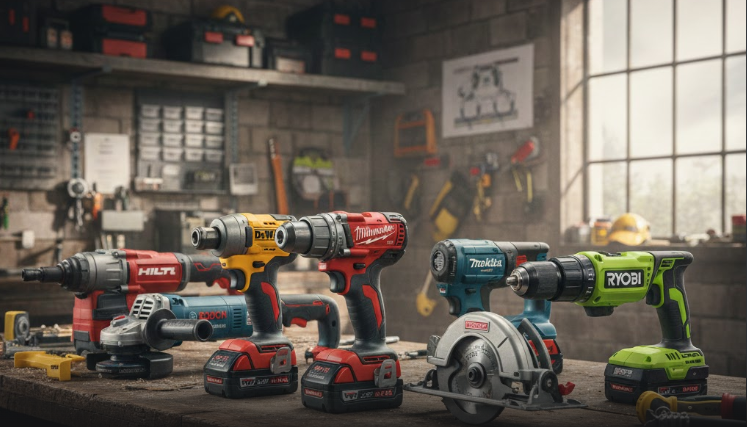
Choosing the best power tool brand used to be simple: you were either a “Team Red” (Milwaukee) or “Team Yellow” (DeWALT) person. However, as we move through 2026, the landscape has shifted. The “best” tool is no longer just about raw power; it’s about ecosystem compatibility, specialized ergonomics, and smart technology.
I use power tools often, and they make my work easier. They help me stay organized, finish faster, and keep full control over every step.
Whether you are a seasoned contractor or a homeowner tackling a weekend deck project, buying into a battery platform is a long-term commitment. This guide breaks down the top performers of 2026 to help you decide which brand deserves a permanent spot in your garage or work truck.
1. The Big Three: Milwaukee, DeWALT, and Makita
In the professional world, three names dominate roughly 85% of the North American market. While they all make excellent drills and saws, they have carved out specific niches where they truly outshine the competition.
Milwaukee Tool: The King of Innovation and Trade Specialty
Owned by Techtronic Industries (TTI), Milwaukee has spent the last decade aggressively targeting specialized trades. If you are an electrician, plumber, or HVAC technician, Milwaukee is likely your top choice.
-
The M18 FUEL™ Line: This remains the gold standard for cordless performance, offering torque levels that were unthinkable just a few years ago.
-
The M12™ Advantage: Milwaukee’s 12V system is arguably the best in the world. It provides “sub-compact” tools that offer near-18V power but fit into the tightest joists and electrical boxes.
-
MX FUEL™: For those looking to ditch gas-powered equipment, Milwaukee’s MX line powers heavy-duty concrete saws and jackhammers with zero emissions.
DeWALT: The Construction Workhorse
DeWALT, a staple of the Stanley Black & Decker family, is the go-to for general contractors and framers. Their tools are built for the grit and grime of a framing site where speed and durability are non-negotiable.
-
60V FlexVolt® Technology: This is DeWALT’s “secret sauce.” These batteries are backwards compatible; they can power a small impact driver at 20V or jump to 60V to power a full-sized table saw or 12-inch miter saw.
-
Rugged Design: DeWALT tools are famously “drop-tested” for real-world accidents. Their yellow-and-black housings are designed to take a beating on a muddy job site and keep on ticking.
Makita: The Precision Specialist
As an independent Japanese manufacturer, Makita approaches tool design with a focus on “internal quality.” While Milwaukee focuses on tech and DeWALT focuses on toughness, Makita focuses on the user experience.
-
Ergonomics and Comfort: Makita tools consistently rank highest for low vibration and balance. If you are using a tool for eight hours a day, the reduced hand fatigue of a Makita drill is a significant health benefit.
-
40V XGT® System: Designed for high-demand applications, the XGT line provides the “smart” communication between battery and motor needed for precision woodworking and heavy-duty masonry.
2. Best Tools for Your Specific Trade
One of the most common mistakes is buying a tool because it’s popular. In 2026, the best tool is the one that was engineered for your specific daily tasks.
Best for MEP (Mechanical, Electrical, Plumbing): Milwaukee
Milwaukee’s Force Logic™ line has changed the game for plumbers and electricians. These tools automate the “pressing” of copper pipes and the “crimping” of heavy electrical lugs, replacing manual labor with hydraulic precision. When you combine this with their extensive lighting and heated gear catalog, they are the undisputed leaders of the indoor trades.
Best for Carpentry and Heavy Framing: DeWALT
Carpentry requires sustained high torque. DeWALT’s PowerStack™ batteries use stacked pouch cells (similar to smartphone technology) to deliver more power in a smaller footprint. For a framer who needs to drive thousands of 3-inch screws a day, the power-to-weight ratio of DeWALT is currently unbeatable.
Best for Woodworking and Fine Finishing: Makita
If your work requires a “finish-ready” cut, Makita is your brand. Their track saws and cordless routers are world-renowned for their accuracy. Makita’s brushless motors run exceptionally cool and smooth, which translates to fewer “burn marks” on expensive hardwoods and less time spent sanding.
3. The Value Kings: Best for Homeowners and DIYers
Let’s be honest: if you only need to hang a few pictures and build a bookshelf once a year, spending $600 on a professional Milwaukee kit is overkill.
Ryobi: The Ultimate Home Ecosystem
Ryobi (also owned by TTI) is the best value brand in 2026. The 18V ONE+™ system now supports over 300 different tools. You can use the same battery for your drill, your lawnmower, your leaf blower, and even your kitchen blender or clip-on fan. For the average homeowner, the convenience of this ecosystem is unmatched.
Craftsman: The Prosumer Choice
Since its acquisition by Stanley Black & Decker, Craftsman has undergone a massive quality overhaul. It sits perfectly between DIY-grade and pro-grade. It is the ideal choice for “prosumers”—people who are remodeling their own homes and want a tool that feels substantial without the professional price tag.
4. Heavy Industrial: When “Pro” Isn’t Enough
For skyscrapers, bridges, and massive infrastructure projects, even the Big Three can struggle. This is where the industrial titans come in.
-
Hilti: Hilti doesn’t just sell tools; they sell “solutions.” Most large construction firms use Hilti’s Fleet Management model, which covers all repairs and replacements for a monthly fee. Their Nuron 22V platform is the current leader in industrial-grade battery performance.
-
Bosch Professional: Known for German engineering, Bosch is the world leader in concrete and masonry. Their PROFACTOR™ tools use high-output batteries designed specifically for high-heat, high-dust environments like tunnel boring or concrete demolition.
Conclusion: How to Choose the Best Brand for You
Choosing the “best” brand ultimately comes down to the Battery Platform. Since batteries are the most expensive part of your kit, you are effectively “marrying” a brand once you buy into their ecosystem.
- Choose Milwaukee if you are a professional in a specialized trade or want the newest tech.
- Choose DeWALT if you are a carpenter, framer, or need a rugged, widely available system.
- Choose Ryobi if you are a homeowner who wants to use one battery for everything in the house and yard.
Frequently Asked Questions (FAQs)
- Is it worth buying 18V or 60V tools?For most users, 18V (or 20V Max) is plenty of power. You only need to jump to 60V systems (like DeWALT FlexVolt or Makita XGT) if you are doing heavy-duty tasks like cutting 4×4 posts all day, mixing large batches of mortar, or using a full-sized miter saw.
- Who makes the best cordless outdoor tools (mowers/blowers)?While Milwaukee and DeWALT are strong, EGO Power+ is currently the leader in battery-powered outdoor equipment. Their 56V platform is dedicated solely to yard work, meaning their mowers and blowers often outperform the outdoor offerings of traditional tool brands.
- Does “Made in the USA” matter for quality?Many brands like DeWALT and Milwaukee are “Made in the USA with Global Materials.” While this is a point of pride for some, the internal electronic components and battery cells are almost universally sourced from the same Tier-1 manufacturers in Asia. Quality is determined more by the Brushless Motor design than the country of assembly.
- Can I use an adapter to use a DeWALT battery on a Milwaukee tool?While these adapters exist, they are generally discouraged. Modern “Smart Tools” communicate with their batteries to prevent overheating. Adapters often bypass these safety sensors, which can lead to a fire hazard or permanent damage to your expensive tools.
- What is the most durable tool brand?If you define durability by “drop-resistance” and weather sealing, Makita and Milwaukee currently lead the market. Makita’s XPT (Extreme Protection Technology) is highly rated for dust and water resistance, while Milwaukee’s housings are designed specifically to survive 10-foot drops onto concrete.