
We’ve all been there. You’re in the zone, sanding a project or detailing a car, and you need to clean up. You drag out the shop vac, unravel the stiff hose that’s permanently coiled like a DNA helix, and get to work. Three minutes in, you’ve hit the end of the tether. You yank the bulky vacuum closer, tripping over the power cord. The hose is now a twisted snake collecting every wood chip on the floor. What should be a simple task becomes a battle.
I work with many vacuum hose extension reel for my projects. The right ones take care of the slow parts, like shaping, cutting, and small fixes. They let me focus more on doing the job well instead of spending long hours on small steps.
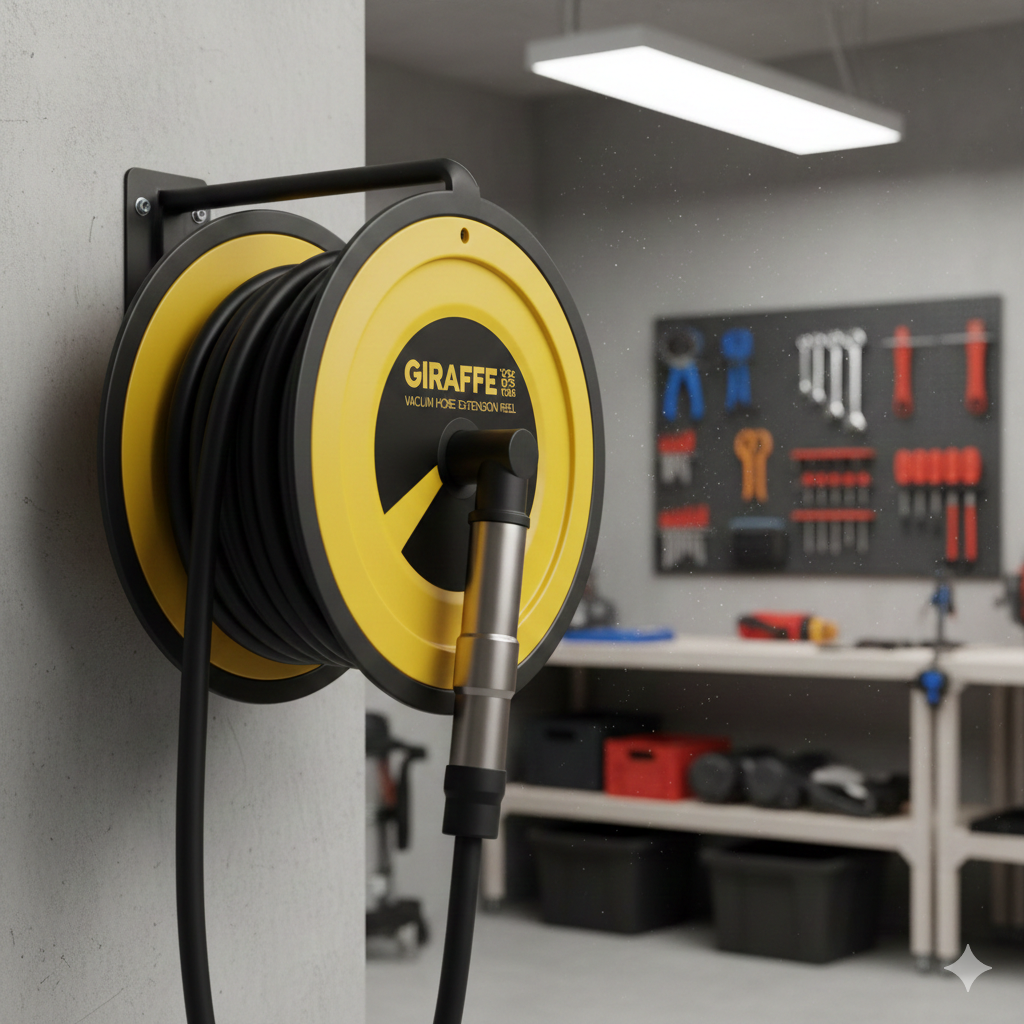
This universal workshop frustration is exactly what the Giraffe Tools Retractable Vacuum Extension Hose Reel is engineered to eliminate.
Here’s what makes this review different:
-
I installed this reel in my own busy home workshop and used it daily for over 30 days.
-
This isn’t a spec-sheet review. It’s based on sawdust, dirt, and real use.
-
I’ll show you the hidden installation trick and the one adapter question you must answer before buying.
What is the Giraffe Tools Retractable Vacuum Extension Hose Reel?
At its core, this is a permanent hose management system. You mount the reel on your wall or ceiling, connect your shop vacuum to it once, and you’re done.
Think of it in three simple parts:
-
The Reel Unit: A durable plastic housing with a spring mechanism, mounted on a steel bracket.
-
The 30-Foot Hose: Pre-installed, crush-proof hose that stores inside the reel.
-
The Connection: An inlet port where your shop vac plugs in, and the hose end you use to clean.
Its job is simple but powerful:
-
Organize: Get the hose off the floor forever.
-
Extend: Clean a massive area without moving your vacuum.
-
Protect: Prevent kinks, crushing, and wear.
This reel is for YOU if:
-
You use your shop vac at least once a month.
-
You’re tired of tripping over or untangling hose.
-
You detail cars, work with wood, or have a dedicated garage space.
Key Features & Specifications: The Promises vs. The Reality
Let’s break down each key feature with what the box says versus what happens in your garage.
1. The Auto-Retract System: Neatness on Demand
-
The Promise: “Automatically and neatly rewinds with a gentle tug.”
-
The Reality Test:
-
What Works: A firm, straight pull triggers a smooth rewind. It’s incredibly satisfying.
-
The Quirk: Pull at a sharp angle, and it can bind. The last few feet sometimes need a nudge.
-
The Sound: You’ll hear a distinct whirr-thump. Not silent, but fine for a workshop.
-
2. The 30-Foot Reach: How Far Will It Really Go?
-
The Promise: “Clean up to 3,000 sq. ft. from a central point.”
-
The Reality Check:
-
The Math: 30-foot radius = ~2,800 sq. ft. of coverage. The claim is accurate.
-
Real-World Example: In a standard two-car garage (24’x24′), I reached every corner, including in front of a parked car.
-
For Car Detailing: You can walk completely around a full-size SUV without dragging the vacuum.
-
3. Universal Compatibility: The #1 Thing to Check Before Buying
This is the most critical section. Getting the wrong fit means the reel won’t work.
Your vacuum hose port size determines what you need:
-
DIRECT FIT (Plugs right in):
-
Shop Vacs with a 1.25-inch (32mm) port.
-
Common Brands: Many models from Craftsman, DeWalt, Ridgid, Shop-Vac.
-
-
NEEDS A COMMON ADAPTER:
-
Vacuums with a 2.5-inch wide port.
-
The Fix: Buy a cheap “1.25-inch to 2.5-inch reducer.” Available anywhere.
-
-
NEEDS A SPECIALIZED ADAPTER:
-
Pro/German Brand Tools like Festool, Mirka, some Makita.
-
The Problem: They use a 35mm/36mm bayonet connection.
-
The Fix: You MUST purchase a separate 1.25″ to 35mm adapter. Giraffe does not include this.
-
Where to Get It: Woodworking retailers like Rockler or Toolnut.
-
4. Durable, Crush-Proof Construction
-
The Promise: “Hard impact polypropylene casing and abrasion-resistant hose.”
-
Hands-On Feel:
-
Housing: Solid, not brittle. Survived accidental bumps.
-
Hose: Thick, rugged vinyl. It feels like it can take abuse.
-
Important Note: When new (and cold), the hose is VERY stiff. It needs a few weeks to “break in” and become more flexible.
-
5. Lock at Any Length
-
The Promise: “Locks with a simple pull so you only use what you need.”
-
Performance Test:
-
How it Works: Pull to length → slight extra tug to lock. Pull again to release.
-
Strength Test: With a 6.5 HP vacuum on max, the lock held firm—no creeping.
-
Purpose: Prevents the vacuum itself from being dragged when you pull the hose.
-
Pros and Cons: The No-Hype Breakdown
✅ Advantages: Why This Reel Earns Its Keep
-
Eliminates Tripping Hazards: Gets a bulky, tangled hose permanently off your floor. This is the single biggest safety and cleanliness upgrade.
-
Saves Time & Frustration: The “pull, clean, tug, done” workflow has zero setup. Research on “micro-frictions” shows reducing small task barriers (like uncoiling a hose) makes you more likely to do the task.
-
Protects Your Hose Investment: A good hose costs $40+. The reel prevents kinks, crushing, and sun damage, extending its life for years.
-
Creates a Professional Shop Feel: It looks organized and intentional, elevating your workspace from a messy garage to a functional shop.
❌ Disadvantages & Honest Considerations
-
Significant Upfront Cost: At $120-$150, it’s a serious investment compared to a $5 hook.
-
Requires Permanent Installation: You must drill into studs and commit to a location. Poor placement leads to regret.
-
Initial Hose Stiffness: The first few weeks, the hose fights you. It needs a break-in period, especially in cooler temperatures.
-
Can Drag Your Vacuum: If your shop vac is on wheels and you yank hard on a locked hose, you might pull the vacuum. Fix: Chock a wheel against the wall.
-
Overkill for Occasional Users: If you vacuum your garage twice a year, this is not a cost-effective tool.
Step-by-Step Installation Guide: Getting It Right the First Time
A proper install is critical. Here’s the foolproof method.
Tools You’ll Need:
-
Power Drill
-
3/16″ Drill Bit (for pilot holes)
-
Stud Finder
-
Level
-
Adjustable Wrench
-
A Friend (Highly Recommended)
Step 1: Make the Strategic Placement Decision.
Don’t just pick an empty wall. Think:
-
For General Shop Use: Mount in the center of your primary work area.
-
For Auto Detailing: Mount near the garage door.
-
Check the Swing: Ensure the hose has a clear 180-degree arc with no shelves in the way.
Step 2: Find Solid Anchoring.
-
Use a stud finder.
-
CRITICAL: You MUST mount into wall studs or ceiling joists. Drywall anchors will fail.
Step 3: Mount the Bracket.
-
Hold the steel bracket level against the studs.
-
Mark the mounting holes.
-
Drill pilot holes.
-
Secure with the provided lag screws. Tighten firmly—no wobble allowed.
Step 4: Hang the Reel & Make Connections.
-
Have your friend help you lift and hook the heavy reel onto the bracket.
-
BEFORE connecting your vacuum: Pull out and retract the hose 5 times. Ensure it winds evenly.
-
Connect your shop vac to the reel’s inlet (use adapter if needed).
-
Connect the hose end to your cleaning tool.
Pro Installation Tip: Mount the reel so the hose exits pointing slightly downward (just 5 degrees). This uses gravity to help the final rewind.
FAQs
Q: Does it work in a cold garage?
Yes, but the hose gets very stiff below 40°F, affecting retraction. Let it warm up or flex it before use. The housing is weather-resistant.
Q: Is there suction loss with the 30-foot hose?
Yes, about 20-30% loss at full length—this is normal physics for any long hose. For heavy debris, use a shorter length or move the vacuum closer.
Q: Is the auto-retract loud?
It makes a mechanical whirr-thump sound, like a drill winding down. It’s normal for a workshop but may startle pets initially.
Q: Can it be repaired if broken?
No. The hose and spring mechanism are not user-repairable. It’s covered by a 2-year warranty for defects. Handle with care to avoid damage.
Final Thought: This is one of those rare tools that disappears into your workflow so completely that you’ll forget how you managed without it. For the serious garage warrior, it’s not an expense – it’s an investment in a better, more efficient, and more enjoyable workspace.